The Execution Paradox™
Why Organizations with Vision, Resources & Capability Still Fail to Execute
You've Seen This Before
Your company builds a strategic plan. Smart people. Real investment. Clear objectives. Leadership buys in.
Six months later, results don't match projections. The plan was solid. The team is capable. The resources were there.
You've hit the Execution Paradox™: the gap between what your organization plans to do and what it can actually deliver.
This isn't about working harder or writing better strategies. You don't have a vision problem. You have an execution problem, and it's costing you far more than you realize.
The Three-Goal Trap
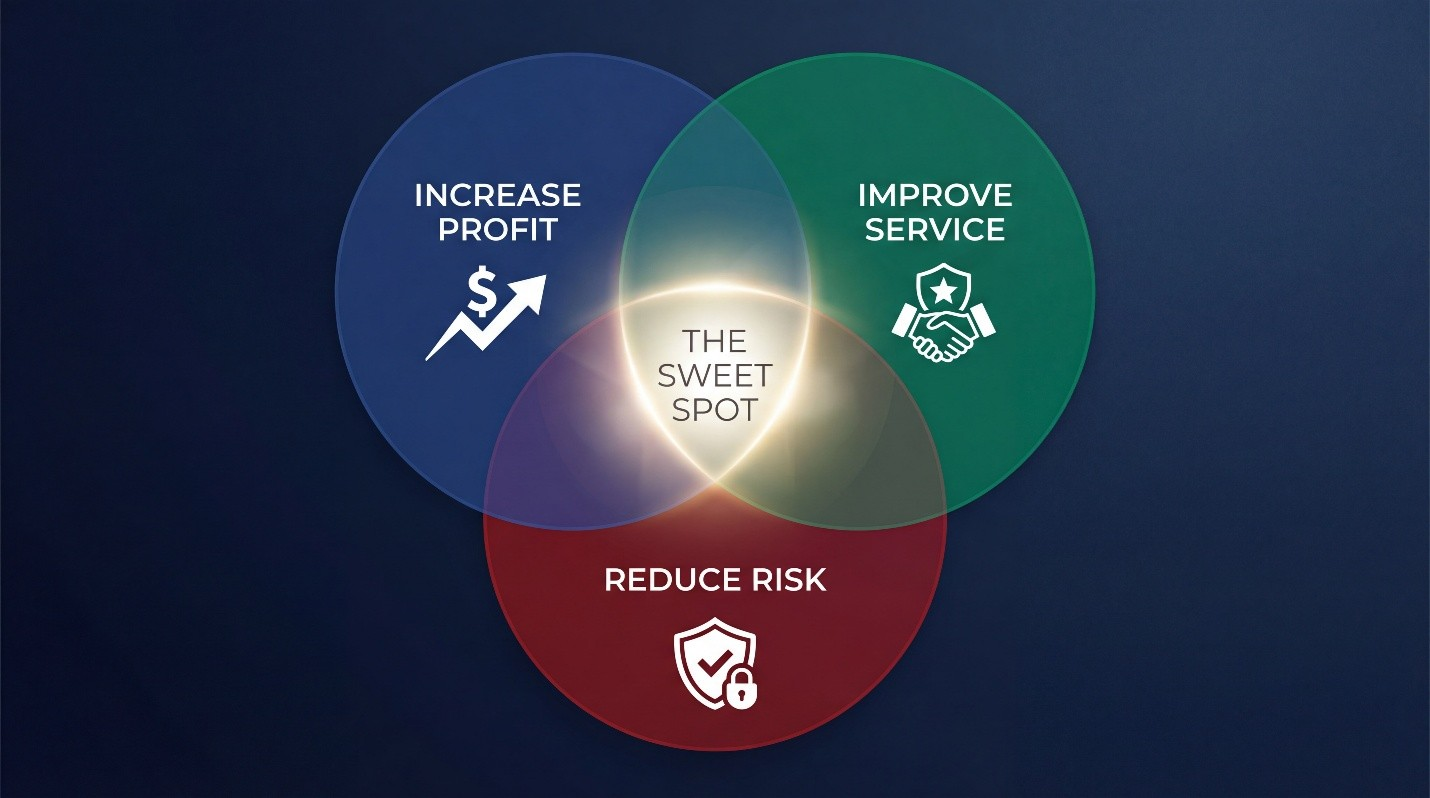
Most organizations believe they must choose between three critical outcomes:
→Profitability (cost reduction, margin improvement, ROI)
→Service Quality (reliability, customer satisfaction, delivery performance)
→Risk Reduction (safety, compliance, operational resilience, retention)
Finance optimizes for cost. Sales for revenue. Operations for service. Compliance for risk.
Nobody optimizes for all three because conventional wisdom says you can't.
You've lived this trade-off: The technology implementation that cut costs but destroyed service. The customer initiative that improved satisfaction while obliterating margins through over-service that provided no competitive advantage. The compliance program that reduced risk but created bureaucracy, costing you employees and business to competitors.
This pattern shows up everywhere, including in how solutions get sold to you. Every vendor promises some combination of these three outcomes. The problem is what they reinforce: the belief that buying the right solution will close your execution gap.
It won't. Research shows 55-75% of ERP implementations fail to deliver expected outcomes (Gartner), often because organizations revert to old behaviors within months of going live.
Why the Gap Exists
The strategy-execution gap isn't created by bad plans or incapable people. It's created by misalignment between what strategy requires and what operations can actually deliver.
When strategy and execution aren't synchronized, organizations optimize individual goals rather than the system. Departments work in silos. Initiatives conflict. Resources get wasted on heroics instead of sustainable capability.
70% of organizational change initiatives fail to achieve their goals (McKinsey), largely due to ingrained behaviors and lack of genuine transformation capability. New processes get documented. Initial metrics improve. Then old habits reassert themselves.
The result? Partial wins that create new problems. Improvements in one area causing deterioration in another. Exhausted teams cycling through initiatives that never stick.
This is the Execution Paradox™: having everything you need to succeed except the ability to make it work together.
The Solution: The Execution Paradox Framework™
Here's what decades of operational transformation has proven: profitability, service quality, and risk reduction don't compete when the strategy-execution gap is closed.
Lower costs enable better service when you eliminate waste rather than capability. Better service drives profitability when reliability replaces heroics. Lower risk improves both when you build systematic processes instead of adding bureaucracy.
World-class organizations achieve all three simultaneously through fundamental alignment between strategy and operational reality.
The Framework addresses four critical elements:
1. Alignment — Structural changes that make strategy and execution move in the same direction at the same speed.
2. Velocity — Building organizational speed where execution matches the pace strategy demands.
3. Synchronization — Redesigning how work flows, decisions get made, and performance gets measured so all three goals reinforce each other.
4. Sustainable Transformation — Making change stick through genuine capability building, not just process documentation. True transformation takes time; research shows habit formation requires 59-66 days minimum (NIH), and most organizations quit long before new behaviors become automatic.
Who This Is For
The Execution Paradox™ hits hardest in organizations facing operational complexity:
→Supply chain and logistics leaders under pressure to deliver lower costs, better service, and greater resilience, while stuck with new initiatives layered on old behaviors
→Manufacturing and distribution executives watching initiatives deliver partial results while new problems emerge
→Private equity portfolio companies that need rapid improvement but can't afford another failed transformation
→Operations teams exhausted from heroically compensating for broken processes
If you have the strategy, the people, and the resources but can't close the gap between plan and performance, you're experiencing the Execution Paradox™.
What's Different Here
Most consulting approaches treat symptoms. They optimize individual goals. They layer new processes on top of broken systems. They develop new strategies without regard for how to undo previous ones.
The Execution Paradox Framework™ fixes the underlying misalignment that creates these problems in the first place.
The pattern is consistent: leaders engage to address a specific problem, usually cost pressure or service failures. What they discover is that the real issue isn't the symptom they called about. It's the execution gap forcing false choices between goals that should reinforce each other.
When that gap closes, improvements appear across all three dimensions simultaneously. The trade-off was never real. It was a symptom.
Let's Close the Gaps
If your initiatives keep delivering partial results, if you're stuck choosing between profitability and service, if every improvement creates a new problem, you're experiencing the Execution Paradox™.
Let's solve it together.
Schedule a Conversation