
Third in a three-part series from Mat Witte's recent podcast appearance on Supply Chain Unfiltered, presented by the Institute for Supply Management. Watch the full podcast here.
View part one here
View part two here
____________________________________________________________
Executive Summary
Parts one and two of this series diagnosed the problem: a 13-percentage-point capacity gap costing $2M–$4.2M annually, and the organizational dysfunction that prevents strategy from reaching the warehouse floor. Part 3 provides the roadmap for fixing it, using generalized examples. Proper, successful use of the format considers company-specific challenges and operating/competitive environment.
The five-phase transformation roadmap: assess honestly, diagnose root causes, prioritize actions, execute with discipline, and build capability. Most organizations fail because they skip honest assessment, misdiagnose root causes, attempt too much simultaneously, abandon efforts when progress slows, and never build internal capability to sustain change.
As emphasized on Mat Witte’s appearance on the Supply Chain Unfiltered podcast, resilience isn't about having all the answers. It's about asking better questions. This article provides the framework for asking those questions and executing the answers.
____________________________________________________________
KEY TAKEAWAYS
The Five-Phase Roadmap:
· Assess Honestly: Measure reality, not assumptions (distributions, not averages)
· Diagnose Root Causes: Keep asking "why" until you reach systemic dysfunction
· Prioritize Actions: Quick wins first, foundations next, technology last
· Execute with Discipline: Push through days 90–270 when enthusiasm fades
· Build Capability: Transfer knowledge and create a continuous improvement culture
Critical Success Factors:
· Fix data quality before buying technology
· Route re-evaluation as ongoing discipline, not one-time project
· Measure outcomes (costs, failures, profitability) not activity (routes planned, completed, miles)
· Build internal capability so improvements sustain after external support ends
Why Most Fail:
· Skip honest assessment to avoid uncomfortable truths and healthy conflict
· Treat symptoms instead of root causes
· Buy technology before fixing processes or having clear strategy
· Abandon efforts during difficult phase (days 90–270)
____________________________________________________________
The Five-Phase Transformation Roadmap
Sustainable transformation follows a disciplined sequence. Skip a phase, and the entire effort collapses.
PHASE 1: Assess Honestly
Most organizations think they know their problems. They don't. They know symptoms, not root causes. Honest assessment means looking at operational reality without defensive reactions or comfortable rationalizations.
Key Questions to Answer:
· What's our actual capacity at departure? (Average: 77-84%; top: 90+%)
· What's the gap between our top 10% and bottom 10% of routes?
· What's our first-attempt success rate? (Benchmark: 98%)
· When were delivery windows last validated? (Should be ongoing)
· What percentage of customer locations are GPS-verified?
· What's our average delivery failure rate and top 5 causes?
Assessment Tools: Operational data analysis (look at distributions, not averages). Driver interviews (they know where plans fail). Customer conversations (actual needs vs. requests). Warehouse observation. Dispatch time during crises.
Why Most Skip This: Assessment reveals uncomfortable truths. But time in assessment saves months of misdirected effort.
____________________________________________________________
PHASE 2: Diagnose Root Causes
Symptoms lie. Systems reveal truth. Moving beyond symptoms requires disciplined thinking and willingness to keep asking "why" until you reach organizational habits or systemic dysfunction.
Example: Trucks departing less than 90% full.
· Surface cause: Poor route planning
· Root cause: Service frequency assumptions from a decade ago that nobody's validated + route assignments based on driver tenure rather than efficiency + data quality issues nobody's fixed + inventory availability disconnect
The framework: Keep asking "why" until you reach something that's a choice, not a constraint. That's your root cause.
Root Cause Categories:
Data Quality: Inaccurate locations, outdated delivery windows, incorrect stop times
Process Dysfunction: Routes designed for convenience not efficiency, no re-evaluation process, no updates to offset high customer turnover and route density challenges
Organizational: Authority misaligned with reality, no escalation paths, silo dysfunction
Technology: Poor data input, lack of integration, automating broken processes
Cultural: "We've always done it this way," fear of change, initiative fatigue
Diagnostic Questions: Where does execution break down? What workarounds exist? (Every workaround points to root causes.) What authority gaps force improvisation?
Why Diagnosis Takes Time: Root causes hide beneath symptoms. Multiple factors contribute. Rushing diagnosis guarantees misdiagnosis.
____________________________________________________________
PHASE 3: Prioritize Actions
Not all problems are equal. Fix high-impact, fast-win issues first to build momentum and organizational credibility.
Implementation Roadmap by Phase (Sample; customize actions to your operation)
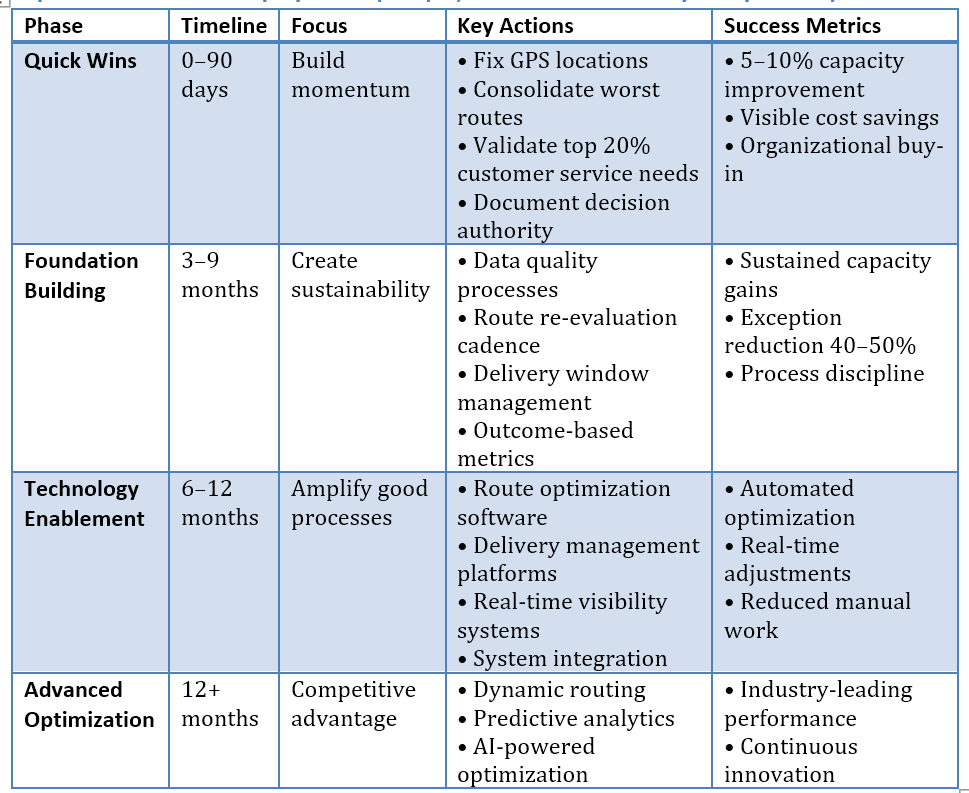
The Sequencing Principle: Fix data → Fix processes → Build capability → Prove basics work → Add complexity. Skip steps and you build on an unstable foundation.
____________________________________________________________
PHASE 4: Execute with Discipline
Planning is easier than doing. This is where most transformation efforts fail. The difficult phase arrives between days 90 and 270. The first 90 days bring enthusiasm and quick wins. Days 90–180 bring hard work and slower progress. Days 180–270 bring the grind and serious questioning.
Most organizations quit during this phase; right before the breakthrough that comes when sustainable improvement becomes cultural shift.
The Execution Essentials:
Execution Essentials:
Clear Ownership: One person accountable per initiative. Authority must match responsibility.
Realistic Timelines: Account for operational constraints. Celebrate progress, not just completion.
Regular Progress Reviews: Weekly check-ins focused on obstacles. Rapid problem-solving. Course correction without abandoning strategy.
Transparent Measurement: Track leading indicators (behavior change) and lagging indicators (business outcomes). Learning orientation, not blame.
Managing Resistance: Resistance emerges around day 90. Expect it. Address directly. Demonstrate early wins. Some won't make the transition.
Key insight: Push through days 90–270. That's where transformation happens.
____________________________________________________________
PHASE 5: Build Capability
Many improvements fade after external support ends because internal capability was never built. You can't sustain what you don't understand. You can't improve what you can't measure. You can't optimize what you don't own.
Knowledge Transfer: Document processes. Train on why, not just what. Build confidence through practice. Goal: team solves future problems independently.
Ownership Transition: Gradual handoff as capability grows. Internal team leads, external advises. Independence, not dependency.
Continuous Improvement: Route re-evaluation becomes discipline (monthly/quarterly). Data quality validation. "How we've always done it" becomes unacceptable.
Capability Test: Six months after: Can team identify opportunities independently? Do they have authority to act? Are improvements sustained? If no, dependency was created.
Framework: Improvement isn't a project. It's how operations run. Excellence becomes normal.
The Capability Test (Six Months After Implementation):
Can your team identify new optimization opportunities without external help? Do they have tools and authority to act? Are improvements sustained or fading? Is capacity utilization holding steady or declining?
If answers are no, capability wasn't built—dependency was created. The initiative will fail when external support ends.
____________________________________________________________
Conclusion: The Path Forward
Closing the strategy-execution gap in final mile operations requires honest assessment of where your operation breaks down, systematic diagnosis of root causes, disciplined execution through difficult phases, and building internal capability for sustainability.
The Roadmap Recap:
Phase 1: Assess Honestly. Measure reality, not assumptions. Look at distributions, not averages. Compare to benchmarks.
Phase 2: Diagnose Root Causes. Keep asking "why" until you reach organizational habits or systemic dysfunction—something that's a choice, not a constraint.
Phase 3: Prioritize Actions. Quick wins first to build momentum. Foundations next for sustainability. Technology last to amplify good processes.
Phase 4: Execute with Discipline. Push through days 90–270 when enthusiasm fades. That's where transformation happens.
Phase 5: Build Capability. Transfer knowledge. Create continuous improvement culture. Make excellence normal, not exceptional.
What Separates Winners:
They challenge "how we've always done it." They measure outcomes over activity. They reset expectations based on reality, not assumptions. They find partners who care about success. They refuse to accept inefficiency as inevitable.
The Final Question:
From the podcast: Resilience is not about having all the answers. It's about asking better questions.
Do you have the discipline to follow the roadmap? The courage to face uncomfortable truths? The persistence to push through when progress slows? The commitment to build capability that lasts?
If yes, the path forward is clear. The roadmap is proven. Organizations following this approach close the 13-percentage-point capacity gap, eliminate 40–50% of daily exceptions, and achieve the strategic improvements that previously stalled.
If no, keep accepting wasted capacity while competitors build advantage.
The diagnosis is complete. The roadmap is clear. When will you start?
____________________________________________________________
Continue the Conversation
Closing the strategy-execution gap requires operational discipline, not just better technology. If your organization is ready to transform final mile operations from cost center to competitive advantage, we can help.
CatalystSC Partners specializes in building the operational excellence that delivers sustainable results. We've helped organizations close the 13-percentage-point capacity gap, eliminate daily chaos and exceptions, and achieve the strategic improvements that previously stalled.
Ready to start your transformation? Let's talk:
📧 **Email:** info@catalystscpartners.com
🌐 **Web:** www.catalystscpartners.com
____________________________________________________________
This concludes the three-part series on closing the strategy-execution gap in final mile operations. View part one here. View part two here.
____________________________________________________________
About the Author
Mat Witte is Founder and Principal of Catalyst Supply Chain Partners, specializing in operational turnarounds and final mile optimization. His career bookends the supply chain software revolution: starting with UPS's commercial software division (Roadnet) in the late 1990s and most recently serving as CEO of ORTEC Supply Chain Planning Americas, where he achieved record pipeline and EBITDA results. Named one of Supply & Demand Chain Executive's "Pros to Know" (2022, 2023) and CIOLook's "Ten Most Iconic Leaders in Supply Chain" (2023), Mat has delivered breakthrough results across private fleet operations, foodservice and beverage distribution, and final mile logistics across industries. This unique perspective – having successfully led organizations on both sides of the software equation - drives his conviction that technology enables excellence only when paired with operational discipline and organizational governance.
All Insights
